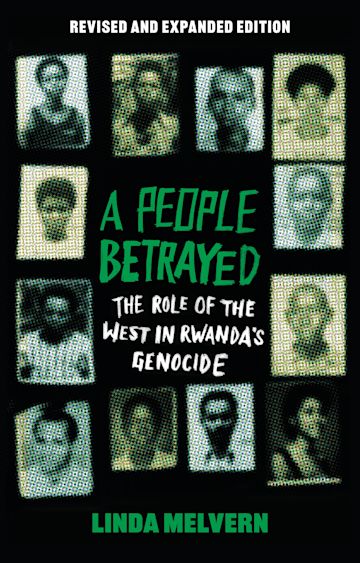
Thirty-one years ago, the 1994 genocide against the Tutsi claimed the lives of one million people. Its scale and intensity, the involvement of Western nations in its preparation, the failure to intervene when the killing began, and the suppression of information about its reality are described in A People Betrayed, first published in 2000, and now in its fourth edition. The book exposed the moral failure at the heart of governments, and the indifference of those professing to honour international law. There was a casual disregard for the provisions of the 1948 Genocide Convention.
This new edition of A People Betrayed adds a final chapter Escaping Justice to address the continuing failure to uphold the provisions of international law and arrest the hundreds of perpetrators still at large, this obligation enshrined in the Genocide Convention. The most wanted fugitive, Félicien Kabuga, indicted as the financier of the genocide, spent 26 years on the run. Kabuga was arrested thanks to traditional police work, tracking the regular visits of his children to his comfortable apartment in a Parisien suburb. An elderly man, justice had come too late. The eventual trial in The Hague beginning in September 2022 was halted half-way through after the defence argued his ill-health, and he was declared unfit to stand trial. This new chapter details the prosecution case outlined in court, allowing a new appreciation of the effects of his radio station, RTLM with its journalists on air enthusiastically endorsing the genocidal endeavour. Kabuga was indicted on seven counts: complicity in genocide, direct and public incitement to commit genocide, attempt to commit genocide, conspiracy to commit genocide, persecution and extermination. Prosecutors said he had a major role in funding a state policy of mass murder. With no country willing to take him, Kabuga remains under the supervision of the International Residual Mechanism for Criminal Tribunals.
For many years, the most serious accusations about its role in Rwanda have been levelled against France. Each successive French government denied journalists and historians access post-genocide to crucial military and political archives including those of President Francois Mitterrand in office during the genocide period. In the face of mounting claims of complicity with the génocidaires, including from the government of Rwanda, in 2019 President Emmanuel Macron decided to open the archives, explaining he wanted a better understanding of an historical tragedy. He guaranteed the independence of a commission of 14 historians to study the evidence. For two years they consulted an estimated 8,000 documents and the eventual report ran to 1,200 pages and was published on 26 March 2021. The findings and conclusions of the report are outlined in the new chapter.
Research into historical sources, including declassified documents, US government cables, and the partial release of some of the UK government archives allow further insight into the decision making of ministers and officials.
The 1994 genocide against the Tutsi has attracted its share of conspiracy theorists. Some argue there was no planning to exterminate the minority Tutsi and there was instead a spontaneous uprising. There is a claim that the victims brought the catastrophe upon themselves. There is said to have been a second genocide (see Intent to Deceive, Verso 2021). This disinformation and denial stalking the 1994 genocide are easily disproved with recourse to widely and publicly available international enquiries, reports, testimony, legal judgements, research and scholarship. This new edition includes a revised list of these sources.
Linda Melvern
July 25, 2024

From the moment when the genocidaires seized state power in Rwanda in April 1994, they determined to distort the perception of events to the outside world, and their skilful use of disinformation was integral to their genocidal conspiracy. In their genocide denial the facts are reversed, fake news promulgated, and phoney science given credence.
The génocidaires and their supporters continue to peddle falsehoods and have found new and receptive audiences and fooled gullible Western journalists and unwary academics. The Rwandan génocidaires continue to pose a threat, especially to those who might not be aware of the true nature of their crime.
The harm to the survivors caused by this campaign of denial is incalculable. Denial devalues the gravity of their experiences and memories. It ensures the genocide is a crime with no end. In allowing denial to continue unchecked we show a callous indifference.
Intent to Deceive published in February 2020, tells the story of this campaign.
“Linda Melvern has made it something of a life mission to take on the Rwandan genocide deniers and debunk their poisonous fact-muddying claims … A clear, crisp and important contribution to the literature on the genocide. In particular Melvern forensically rebuts attempts by apologists for the genocidaires, including western academics, to suggest a moral equivalence between the parties in Rwanda.” – Alec Russell, Financial Times
“This book is a fine and exceptionally well-written microscopic examination of the denial phenomenon relating to the genocide of Tutsis in Rwanda in 1994. It contributes, together with the author’s other work on Rwanda, to an absolutely indispensable body of forensic and historical work for all who want to understand the stages of this genocide – from its early dynamics to those who would now deny it.” – Ken Booth FBA, presently Distinguished Research Professor and formerly EH Carr Chair in the Department of International Politics, Aberystwyth University, and a former Chair of the British International Studies Association
Intent to Deceive
Verso Books 2020
“A brilliant and incisive book about those who continue to deny the 1994 genocide against the Tutsi in Rwanda.”
Simon Adams

Conspiracy to Murder
Verso 2004
Paperback 2006
Three Editions
Voted the Best Book on Africa by Foreign Affairs and Outstanding Academic title in 2004 by Choice.
“Essential …. quite possibly the definitive account of the origins of the tragedy. Melvern relies heavily on material that had not been available to earlier researchers, such as captured Rwandan government documents… Scholars will appreciate the meticulous research and extensive endnotes. Melvern’s writing is clear and direct. Accessible to all readers.” Choice
The Ultimate Crime
Allison and Busby 1995
“…the 1990’s has seen something of proliferation of books on the UN. Linda Melvern’s book deserves a place on or very near the top of the pile…. this is a hidden history of the UN, indeed of the post-1945 world which will be of value to academics and the general reader. It is a major work of fact and argument which deserves considerable attention from those wanting to know how the UN worked during its first 50 years.”
Dr. Mark Imber

Linda is a British investigative journalist, the author of seven non-fiction books. For several years she worked for London’s Sunday Times recruited from the newsroom to join the investigative Insight team.
For the past 27 years she has researched and written extensively on the circumstances of the 1994 genocide of the Tutsi in Rwanda. A consultant to the Military One prosecution team at the International Criminal Tribunal for Rwanda (ICTR), documents from her extensive archive were used in this trial. She is a former Honorary Professor in the Department of International Politics, University of Wales and former second vice-President of the International Association of Genocide Scholars.
 Linda Melvern